
Cart
0
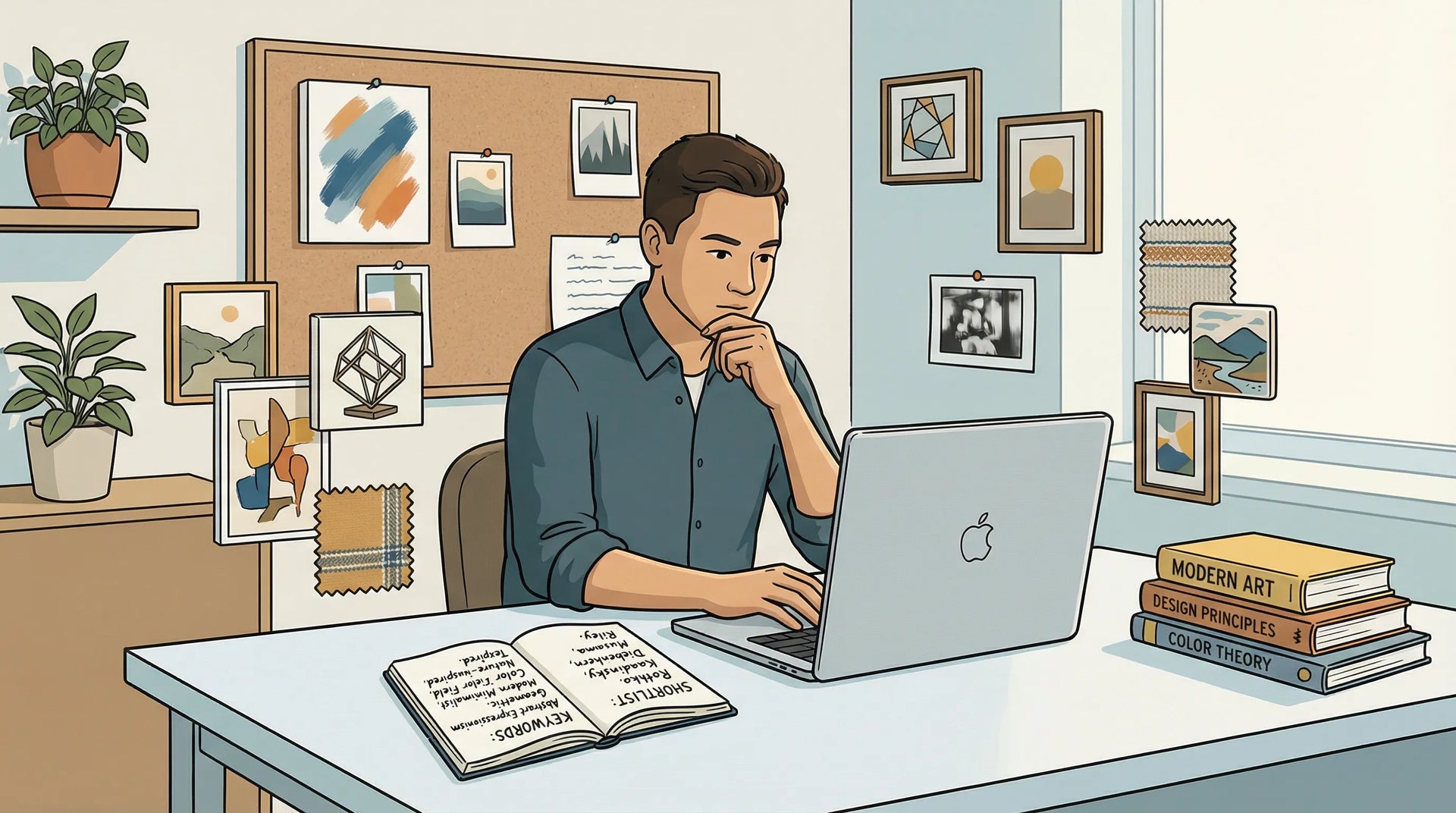
You can find incredible artists online in less time than it takes to watch an episode of a series, but only if you search in a way that beats algorithms, avoids scams, and turns “nice” into “I want this on my wall”. The goal is not to scroll endlessly. It is to build a repeatable discovery system that helps you spot artists whose work fits your taste, your space, and your budget.
Below are 7 proven tactics (used by curators, designers, and serious collectors) to find an artist online and shortlist work you will still love next year.

1) Start with a “taste profile” (so the internet stops overwhelming you)
Most people try to find an artist online by searching for “cool wall art” or “modern prints”. That tends to produce whatever is currently over-promoted, not what fits you.
Instead, create a quick taste profile you can reuse everywhere (Instagram, Pinterest, marketplaces, and even museum archives). Aim for constraints that are visual and specific.
Write down:
- Subject: abstract, landscape, figure, typography, still life, architecture, animals
- Mood: calm, playful, intense, minimalist, nostalgic, futuristic
- Palette: warm neutrals, monochrome, primary colours, earthy greens, high-contrast black and white
- Medium feel: painterly, graphic, photographic, collage, linework
- Format: portrait vs landscape, diptych/triptych, oversized statement vs small series
This step matters because discovery platforms rank content based on engagement, not your home. A taste profile gives you an objective filter.
2) Use visual search (it is faster than keywords for finding “similar artists”)
When you have even one image you love (a poster you saw in a cafe, a piece on a hotel wall, a photo saved from Instagram), visual search can lead you to whole clusters of artists.
Practical ways to do it:
- Google Lens: upload or point your camera at an artwork to find visually similar results.
- Pinterest visual search: search from a pin to discover artists with a related palette and composition style.
- Bing Visual Search: often surfaces different sources than Google, which is useful for cross-checking.
Two important notes:
- Do not assume the first match is the original artist. Visual search frequently returns reposts, aggregators, or unlicensed listings.
- Use visual search to map the style neighbourhood, then verify authorship (see tactic #7).
3) Search social platforms like a curator (not like a casual scroller)
Social media is still one of the best ways to find an artist online because you can see process, consistency, and how the work looks in real spaces. The trick is to search in a structured way.
Build “signal” searches
Instead of broad tags (#art, #illustration), use combinations that reflect your taste profile:
- Style + medium: “abstract gouache”, “risograph print”, “graphic linocut”, “minimal ink drawing”
- Style + subject: “architectural photography print”, “botanical line art”, “surreal portrait illustration”
- Palette + style: “monochrome abstract”, “earth tone poster”, “pastel geometric art”
Use location and scene filters
Many strong artists do not optimise for global reach, they optimise for their local collector base.
Try:
- geotags for design fairs and open studios
- searches like “printmaker Manchester”, “illustrator Bristol”, “studio sale London”
Look for proof of a real practice
A credible artist account usually shows at least some of:
- work-in-progress, sketchbook pages, test prints
- consistent lighting and documentation
- exhibitions, collaborations, or studio shots
- comments from real collectors (not only generic bot praise)
4) Mine portfolio platforms for depth (Behance, Dribbble, ArtStation, and beyond)
Social platforms are great for discovery, but portfolio platforms are better for evaluating whether an artist has range and intent.
Use them differently:
- Behance is strong for editorial illustration, graphic design, typography-led art, and cohesive series.
- Dribbble can surface bold graphic styles quickly, but it is more “design snippet” oriented.
- ArtStation is excellent for cinematic, fantasy, and concept-art aesthetics.
When you land on a profile, do not just look at the best piece. Look for:
- series thinking (sets that could become a gallery wall or a themed room)
- repeatable visual language (a signature, not randomness)
- print suitability (clean edges, intentional grain, readable contrast)
Platform cheat sheet
| Platform type | Good for finding | What to watch for | Best next step |
|---|---|---|---|
| Instagram / TikTok | Emerging artists, process, styling | repost accounts, uncredited work | follow the artist, then check their shop/portfolio links |
| Style clusters, colour palettes | attribution can be messy | reverse image search to confirm the creator | |
| Behance / Dribbble | Cohesive bodies of work | some work is client-owned | check if prints are available or if it is commercial-only |
| ArtStation | High-skill illustration and concept styles | AI-generated work is mixed in | verify workflow and consistency over time |
| Online galleries / marketplaces | Buying-ready listings | price inflation, unlicensed copies | check terms, provenance, and seller credibility |
5) Follow curators, galleries, and “selectors” (they do the filtering for you)
If you want higher signal with less scrolling, borrow taste from people whose job is selection.
Where to look:
- contemporary galleries (even if you buy prints rather than originals)
- museum online collections to discover artists historically and trace influences
- magazines and editorial platforms that profile illustrators, photographers, and printmakers
This tactic works because curators tend to select for coherence and longevity, not only trendiness.
Useful starting points:
- Tate collection to explore artists and movements
- The British Museum collection for prints, drawings, and historical references
- V&A collections for design, poster history, typography, and illustration
Once you find one artist you like in a curated context, look at:
- who they exhibit with
- which group shows they appear in
- what other artists are linked by movement, medium, or geography
That network effect is one of the fastest ways to discover artists with a similar calibre.
6) Use “adjacent industries” to discover artists before they trend
Some of the best art for walls comes from artists who are visible in design, music, publishing, or fashion long before they are famous in “fine art” spaces.
Places to hunt:
- record label artwork and gig posters (screen print culture is a goldmine)
- book covers and editorial illustration (strong composition, print-friendly)
- architecture and interior design projects (photographers and abstract artists often appear here)
- brand collaborations (often credited, often linked to the artist’s shop)
How to do it practically:
- Find a cover or poster you love.
- Identify the designer or illustrator credit.
- Search that name plus “print”, “poster”, or “shop”.
- Then check who they follow and collaborate with.
This is one of the most reliable “early discovery” paths because the work is already being commissioned and art-directed.
7) Verify authorship and buying rights (so you support the real artist)
The hardest part of finding an artist online is not discovering images, it is confirming you are buying from a legitimate source.
This matters because stolen artwork and unauthorised reproductions remain common across the internet, especially for posters.
A quick authenticity checklist
Use this before you buy:
- Confirm the original source: does the artist post the work on their own verified channels (site, portfolio, or long-running social account)?
- Check consistency: does their body of work look like it came from the same hand across months or years?
- Look for licensing clarity: if a marketplace seller is not the artist, do they state they are licensed to sell reproductions?
- Reverse image search the listing image: if the same artwork appears across dozens of suspicious shops, treat it as a red flag.
- Read the terms: personal display is different from commercial use. Copyright basics are worth understanding, the UK Intellectual Property Office is a reliable reference point.
What “good” looks like for prints
If you are buying posters or art prints (rather than originals), you are usually looking for:
- clear sizing information
- paper and print method described (for example, archival or giclée style printing, depending on the seller)
- colour-accurate previews, ideally with room mockups
- a returns policy and secure checkout
If you are shopping from a curated print marketplace, the key question is simple: is the artist credited and is the print sold with the right to reproduce? When that answer is clear, you can buy with confidence.
A 15-minute workflow to find an artist online and build a shortlist
Use this repeatable routine whenever you want new wall art inspiration.
- Pick one anchor style from your taste profile (for example “monochrome abstract with texture”).
- Run a Pinterest search and save 10 images that match the vibe.
- Use visual search on the top 2 images to find likely creators and similar works.
- Jump to Instagram or Behance and open 8 to 12 artist profiles.
- Shortlist 3 artists using only two rules: you would hang multiple pieces from them, and their work looks consistent over time.
- Verify authorship (reverse image search plus checking the artist’s own channels).
- Decide the practical constraints: size, orientation, framing, and budget.
You can repeat this monthly and build a personal “bench” of artists whose work you genuinely connect with.

How to choose between artists when everything looks good
When you have multiple favourites, make the decision based on fit, not hype.
A simple decision grid:
| Criterion | What to ask | Why it matters |
|---|---|---|
| Emotional pull | Would you still want this up after 6 months? | Wall art is daily exposure, not a one-time thrill |
| Palette match | Does it harmonise with your room’s main colours? | Reduces “impulse mismatch” regret |
| Scale | Is the main subject readable from where you sit? | Prints can fail if they are too small or too busy |
| Pairability | Can you imagine 2 to 3 pieces together? | Helps you build a collection, not single orphans |
| Provenance | Is the artist properly credited and the print legitimate? | Ensures you support the creator and get quality |
If you want an extra practical tie-breaker: choose the artist whose work you can imagine living with in different seasons (light changes, mood changes, furniture changes). That is often the difference between “nice” and “lasting”.
Final thought: discovery is a skill you can systemise
To find an artist online consistently, treat it like building a playlist. Define your taste, search visually, follow curators, explore adjacent industries, and always verify the source before you buy. The more intentional your discovery process, the more your walls will feel like you, not like an algorithm.


