
Cart
0
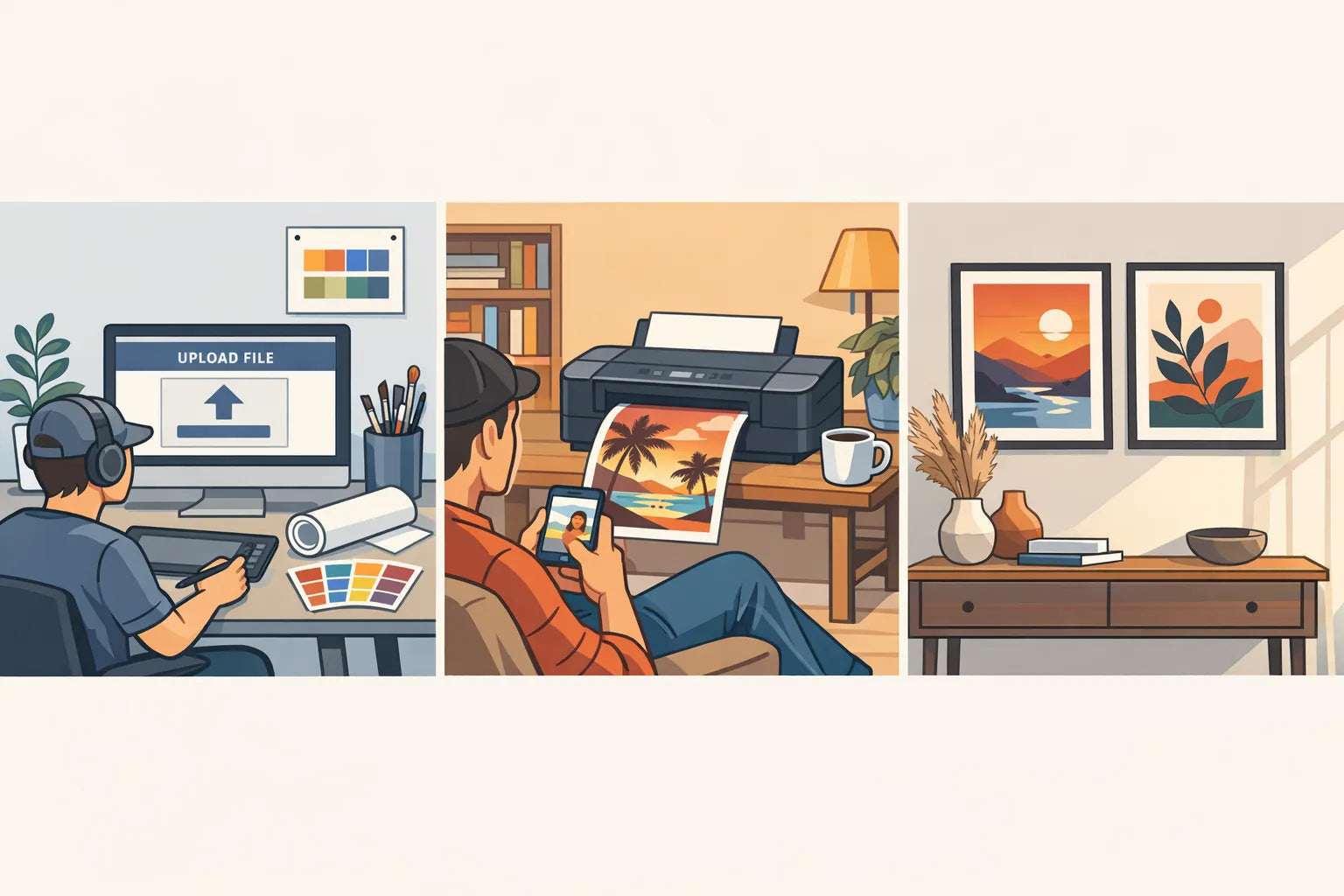
Choosing the best place to print posters online in 2025 is less about finding a single “cheapest” website and more about matching a printer (or print retailer) to what you actually need: colour accuracy, paper quality, framing, turnaround time, and the confidence that what arrives will look like it did on screen.
If you are printing your own artwork or a designed poster, you want a print lab with strong colour management and predictable materials. If you are buying art to decorate a space (rather than uploading a file), you want a curated art-print store that produces consistent, ready-to-hang pieces.
Below is a practical way to decide which option is genuinely the best for you, plus a checklist you can use before you click “order”.
What “best place” really means for poster printing
In 2025, online poster printing split into three common paths:
- Online print labs that print your uploaded file (often the best choice for designers, photographers, and businesses).
- Mass-market photo/product printers that do “posters” alongside lots of other products (fine for casual use, variable for colour-critical work).
- Curated art-print retailers that sell posters and prints created by artists (best when you want a finished artwork, often with framing options).
The “best place” depends on which of these outcomes you want:
- Exact colour matching (brand colours, illustration, photography)
- Museum-style finish (fine art paper, pigment inks, longevity)
- Budget quantity (events, signage, student projects)
- A ready-to-hang art piece (framed options, consistent presentation)
A quick decision guide (pick your best option)
Use this as your first filter before comparing specific vendors.
| Your goal | Best type of place to use | Why it wins | Watch-outs |
|---|---|---|---|
| Print your own design for a client, shop, or brand | Online print lab with colour profiles and proofing | Predictable output, pro papers, better consistency | Can be pricier, more choices to get wrong |
| Print a casual poster from a phone photo | Mass-market photo printer | Simple ordering, frequent promos | Colour and sharpening can be inconsistent |
| Decorate home or office with high-quality art | Curated art-print retailer (made-on-demand) | You choose art, size, and often framing, less technical setup | You are buying the art, not printing your own file |

The 9 criteria that separate great online poster printing from disappointing prints
If you only compare price and size, you will eventually get burned, usually by dull blacks, muddy shadows, weird skin tones, or paper that feels like thin office stock. In 2025, these are the criteria that matter most.
1) Print method and inks (durability and colour stability)
For art and photography, look for pigment inks (often marketed as “giclée” in fine art contexts). Pigment inks generally offer better longevity than dye-based inks. If a company is vague about inks, treat it as a yellow flag.
If you want to understand the basics of why colour management matters from capture to output, Adobe’s overview is a good starting point: colour management concepts.
2) Paper quality (finish, texture, and weight)
Paper is not a detail, it is half the product. Two posters printed from the same file can look completely different on different papers.
What to look for:
- Weight (gsm): Many people prefer something in the 200gsm plus range for a “proper” poster feel (not a rule, but a useful benchmark).
- Finish: Matte reduces glare (great for bright rooms), satin is a balanced all-rounder, gloss can pop but shows reflections.
- Texture: Smooth for modern graphics, lightly textured for a more “art paper” look.
Paper manufacturers like Hahnemühle and Canson Infinity publish detailed specs, which can help you learn what to ask a printer.
3) Colour management and ICC profiles
If you care about accuracy, the printer should either:
- Provide ICC profiles for their printers and papers, or
- Give clear guidance on working colour spaces and proofing
Professional print labs often align with established colour standards and workflows. Industry organisations like Fogra are widely referenced in colour management and printing standards.
4) File requirements (resolution and sizing)
The most common reason posters look “soft” is that the file was not built for the final print size.
Practical targets:
- 300 ppi at final size is a classic benchmark for high-quality prints viewed up close.
- Large wall posters can sometimes be fine at lower ppi if viewed from further away, but do not rely on that unless you understand the trade-off.
Also check whether the printer expects:
- Bleed (extra image area trimmed off)
- Safe margins (to avoid important text getting cut)
5) Proofing options (your insurance policy)
If you are printing something important (a gift, a paid client job, an exhibition piece), look for at least one of these:
- A paid or discounted test print
- A smaller size print first
- A clear reprint policy if the output is wrong due to production error
6) Size range and aspect ratios
Posters fail aesthetically when people choose a size that does not match the image proportions, then crop important elements.
A good provider makes it easy to order common standards (A-sizes in the UK and EU, popular inch sizes elsewhere) and clearly shows if your file will be cropped.
7) Framing and “ready-to-hang” options
If the poster is going straight onto a wall, framing is not an afterthought. Consider:
- Do you want framed and ready to hang, or rolled in a tube?
- Do they offer frame colours and styles that suit your space?
- Is glazing acrylic or glass (impact resistance and glare differ)?
If your real goal is wall-ready decor, it can be smarter to buy from a retailer that focuses on finished art prints rather than a generic print shop.
8) Packaging, shipping, and damage handling
Even excellent prints can arrive ruined if packaging is weak. Look for:
- Sturdy tubes or flat packaging with corner protection
- Tracked shipping
- A clear “arrived damaged” resolution path
Also, if you are ordering internationally, consider customs duties and delivery times.
9) Transparency and customer service
A surprisingly strong proxy for quality is how clearly the company explains:
- Materials (paper type, ink type)
- Production method (made-to-order vs pre-printed)
- Turnaround times
- Returns and reprints
If details are hard to find, you are taking a gamble.
What’s new in 2025: expectations that changed how people choose printers
Compared with a few years earlier, buyers in 2025 increasingly expect:
- Made-on-demand production (less waste, more size options)
- Reliable international fulfilment (tracking and predictable delivery windows)
- Better consistency across batches (especially for creators selling prints)
- Premium framing options without needing a local framer
That is why “best place” has become more about consistency and finish, not just access to a printer.
A practical checklist before you order posters online
Run through this once, and you will avoid most disappointment.
- Confirm the final size you want on the wall (measure the space, not your screen).
- Match aspect ratio (do not force a 3:2 photo into an A-size frame without checking the crop).
- Export correctly (right dimensions, high-quality JPEG/TIFF, embedded profile if required).
- Decide on paper finish based on lighting (matte for glare-heavy rooms).
- Order a test print if colour accuracy matters.
- Plan framing early (frame size affects border choices and composition).
If you’re printing your own poster file: what to ask a print lab
When you are evaluating print labs, these questions quickly reveal whether they are set up for quality work:
- What ink technology do you use (pigment or dye)?
- What paper brands and weights do you offer?
- Do you provide ICC profiles or soft-proof guidance?
- What resolution do you recommend for the final print size?
- How do you handle reprints for production defects or shipping damage?
You do not need a “perfect” answer to every question, but you should get clear answers.
If you’re buying art posters (not uploading a file): what “best place” looks like
Many searches for “best place to print posters online” are really about finding great wall art, not operating a print workflow.
If you want art that looks considered and arrives ready to display, the best option is often a specialist art-print retailer that focuses on:
- Curated artwork from contemporary artists
- Multiple size options
- Optional framing
- Made-on-demand printing (so the print is produced for your order)
- Straightforward shipping (ideally free) and worldwide delivery support
Dreamprint.art sits in this category: it is a curated marketplace for ready-to-hang posters and art prints, produced on demand with multiple sizes and framing available, plus free shipping and international support. If your goal is to elevate a room rather than print a file you designed, that distinction matters.

Common mistakes that make online posters look cheap (and how to avoid them)
Choosing glossy paper for a bright room
Gloss can look great in controlled lighting, but in many homes it creates reflections that hide the artwork. If the wall faces a window, matte or satin is often safer.
Ordering the wrong size for viewing distance
A small print on a large wall reads as “temporary”. Conversely, a huge poster in a tight hallway can feel overwhelming. Measure the wall and visualise with painter’s tape before ordering.
Over-sharpening and heavy noise reduction
These edits can look fine on screen but turn ugly in print, especially on textured fine art papers. Use restrained sharpening and keep an eye on skin tones and gradients.
Using low-resolution images from social platforms
Images downloaded from messaging apps or social media are often compressed. If possible, go back to the original export or source file.
Bottom line: the best place to print posters online in 2025 depends on your intent
- If you need precision and repeatability for your own files, choose a quality-focused online print lab with transparent papers, colour management guidance, and a sensible proofing path.
- If you want wall-ready art, the best “place to print” is often not a printer at all, but a curated art-print store that produces consistent, made-on-demand prints and offers framing.
Once you decide which category you are in, it becomes much easier to compare providers, because you will be judging them on the right criteria, not just price per size.

