
Cart
0
Buying art online can feel like a win win: you get a statement piece for your home, and a “deal” makes it even sweeter. The problem is that not every discount is a real saving. Some promotions rely on inflated “was” prices, confusing size comparisons, or extra costs (like framing) that erase the headline bargain.
This guide shows you how to judge art deals today like a pro, so you can buy posters and art prints with confidence, not regret.
What “real savings” actually means for art prints
A genuine art deal is not only about the lowest number on the screen. It is about paying less for the same thing, or getting more value for the same money.
For posters and art prints, value usually comes from:
- The print size (and whether you are comparing like for like)
- Paper quality and finish (matte, gloss, textured)
- Print method and colour durability (for example pigment inks vs dye inks)
- Framing (included or optional, and what quality)
- Shipping and returns (especially for large prints)
If any of those variables change, a “50% off” can be meaningless.
How to spot real art deals (and avoid fake discounts)
1) Compare like for like (size is the most common trick)
The simplest way to mislead shoppers is to discount a smaller print and let your brain assume it is the size you actually want.
Before you decide a deal is good, confirm:
- Exact dimensions (in cm or inches)
- Orientation (portrait, landscape, square)
- Whether the image has borders that reduce the visible artwork area
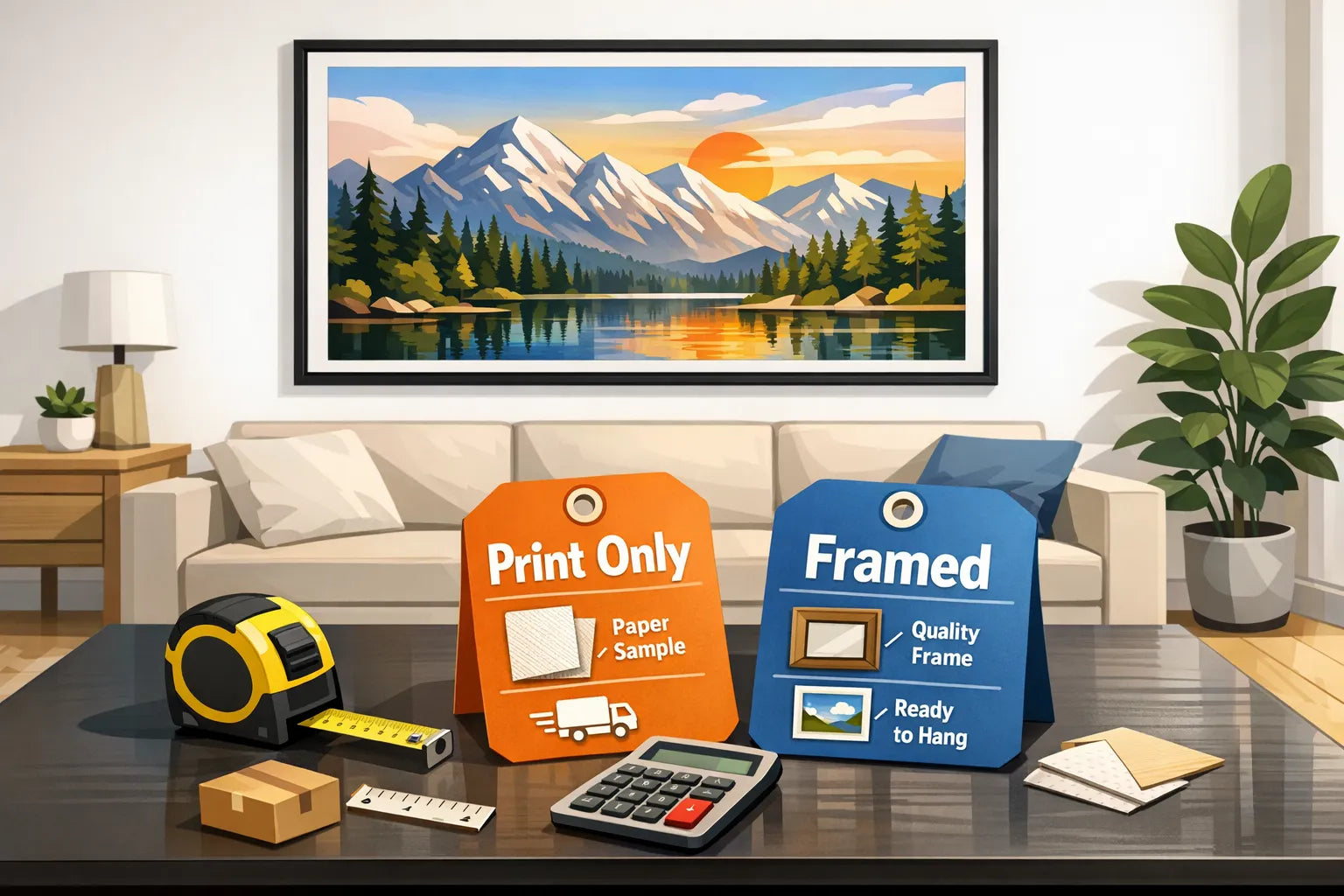
- Whether the price shown is for “print only” or “framed”
A good habit is to compare value using price per area.
| What you compare | Why it matters | Quick check |
|---|---|---|
| Size (e.g., 30×40 vs 50×70) | Bigger prints can look “only slightly” pricier but are much larger | Calculate area (width × height) |
| Print only vs framed | Frames can cost as much as the print | Confirm what is included |
| Finish and paper | Cheaper materials can look fine online but disappoint in person | Look for clear material specs |
2) Be sceptical of “was/now” pricing (especially if it is always on sale)
In the UK, pricing claims are scrutinised. The Competition and Markets Authority (CMA) explains that reference prices (like “was £X”) should not mislead shoppers about the genuine saving, and should reflect real pricing history and practice. You can read the CMA’s overview in its guidance on pricing practices.
Practical signals a discount might be weak:
- The “was” price looks unusually high for that size/category
- The sale appears permanent (same discount week after week)
- There is always a countdown timer that resets
This does not automatically mean the shop is dishonest, but it does mean the deal might not be as special as it looks.
3) Check whether the deal is “discounted” or “discountable”
Some retailers inflate perceived value by discounting a product that was never realistically meant to sell at full price.
To reality check:
- Compare similar sizes across multiple reputable art print sellers
- Compare the seller’s own range (if everything is 60% off, nothing is)
- Look for a normal price distribution (some items full price, some discounted)
If you want a UK specific reference point for how price promotions should be presented, the Advertising Standards Authority has guidance on misleading advertising and pricing claims.
4) Do the “all in” total, including the costs that quietly erase savings
A poster can look like a bargain until you add:
- Shipping
- Taxes or duties (when buying internationally)
- Framing
- Returns (especially if return shipping is on you)
A retailer offering free shipping can be a genuinely meaningful saving on large wall art, because oversized parcels often cost more than people expect.
When comparing two deals, always compare the delivered price for the same size and setup (print only vs framed).
5) Ask: “What am I actually paying for, the artwork, or the marketing?”
Real value in art prints often comes from clear production standards. You do not need to be an expert in printing, just look for transparency.
Signs of a quality focused seller:
- Clear paper description (weight, finish, texture)
- Clear framing options and materials
- Real product photography (close ups help)
- Straight answers about how prints are produced and shipped
If those details are missing, the “deal” can end up being expensive if you need to replace the print after a year, or if it arrives damaged and support is slow.

6) Separate “limited” language from genuinely limited editions
Terms like “exclusive”, “rare”, or “limited time” can refer to marketing, not scarcity.
If scarcity matters to you, look for specifics:
- Is it a limited edition with a stated run size?
- Is it numbered (e.g., 12/100)?
- Is there documentation or artist information?
Posters and open edition prints can still be beautiful and worth buying, but they should not be priced like scarce editions just because a landing page says “limited”.
7) Don’t let framing turn a good deal into a bad one
Frames change everything, visually and financially.
A smart way to judge a framed deal is to break it into two questions:
- Is the print price fair for the size and quality?
- Is the frame upgrade priced fairly compared to buying a frame separately?
What to look for in framing options:
- Is the frame style clearly shown from multiple angles?
- Are sizes standard (so you can reframe later if you want)?
- Is the framing described as ready to hang?
Even when a frame add on is not the cheapest route, it can still be good value if it saves time, avoids mismatched sizes, and arrives ready to go.
A quick “deal calculator” you can use in 30 seconds
You do not need a spreadsheet. Two quick calculations can keep you grounded.
Cost per area (to compare different sizes)
- Print area = width × height
- Cost per area = delivered price ÷ print area
Example (illustrative only):
| Option | Size | Delivered price | Area | Price per 1,000 cm² |
|---|---|---|---|---|
| A | 30×40 cm | £29 | 1,200 cm² | ~£24.17 |
| B | 50×70 cm | £49 | 3,500 cm² | ~£14.00 |
Even though B costs more, it may be the better deal for wall impact per pound.
“Frame penalty” (to judge framed bundles)
- Frame penalty = (framed delivered price) minus (print only delivered price)
If that penalty feels reasonable for the convenience and the look, it is a good value upgrade. If it is huge, you might buy the print and frame it locally.
Where real art deals usually come from (without sacrificing taste)
The best savings tend to come from predictable places, not random flash sales.
Seasonal promotions (when people actually redecorate)
Home refresh moments often trigger legitimate promotions:
- January (new year reset)
- Spring (lighter palettes, new interiors)
- Late summer (back to routine, home office upgrades)
- Black Friday/Cyber Week (often strong, but still compare carefully)
Multi buy savings (best for gallery walls and pairs)
If you are planning more than one piece, bundles can be genuinely cost effective because shipping and handling efficiencies increase.
Clearance or last chance sections
These can be real deals when:
- The seller is rotating styles
- A specific size or colourway is being discontinued
Just make sure you still like it on your wall, a cheap print you do not love is not a saving.
Safety checks when buying art prints online
A deal is only a deal if the buying experience is smooth and the outcome matches the listing.
Before you checkout, look for:
- Secure payment and clear checkout steps
- Clear delivery expectations and tracking
- A straightforward returns policy
- Responsive customer support or a clear contact page
In the UK, the Consumer Rights Act 2015 and related consumer protections exist to help ensure goods are as described and of satisfactory quality. (This is not legal advice, but it is worth knowing the basics if something arrives damaged or not as described.)
How to use Dreamprint.art for smarter art deals
If your goal is to find wall art you will genuinely enjoy living with, the smartest “deal strategy” is to combine price awareness with quality signals.
Dreamprint.art positions itself around practical value points that matter when you are deal hunting:
- Made on demand printing (so you are not limited to leftover stock)
- Ready to hang options and framing available (for a faster, cleaner setup)
- Free shipping (often a real saving for larger prints)
- A wide choice of styles, sizes, and themes for home or office spaces
When you browse, apply the checks from this guide (like comparing size, verifying what is included, and calculating the delivered total). That way, when you spot a deal, you will know it is a deal.

Frequently Asked Questions
How do I know if an art deal is real? A real deal holds the product constant: same size, same finish, same framing (or no framing), and the delivered total is genuinely lower than comparable options. If size or inclusions change, the “discount” can be misleading.
Is it better to buy framed or print only? It depends. Framed is often worth it if you want a ready to hang result and do not want the hassle of sourcing the right frame. Print only can be cheaper if you already have frames or can buy them locally at a good price.
Do bigger prints usually offer better value? Often, yes. Larger sizes can have a lower price per cm², so the cost per wall impact can be better. Always compare delivered totals, not just headline prices.
Are countdown timers and flash sales always a red flag? Not always, but they are a reason to pause. If the timer resets frequently or the sale looks permanent, treat it as normal pricing and compare with other retailers.
What hidden costs should I watch for with wall art? Shipping, taxes/duties, framing, and return shipping are the main ones. A deal with free shipping can beat a bigger discount once you compare the delivered total.
What should a good online art store tell me about a print? At minimum: the size options, paper/finish details, framing options (if offered), delivery expectations, and a clear returns policy.
Find art you love, at a price that makes sense
If you are ready to shop without falling for fake discounts, start with a quick browse of what fits your space and budget, then apply the “real savings” checks above.
Explore posters and art prints at Dreamprint.art and focus on the deals that stay strong after you compare size, inclusions, and delivered total cost.

