
Winkelwagen
0
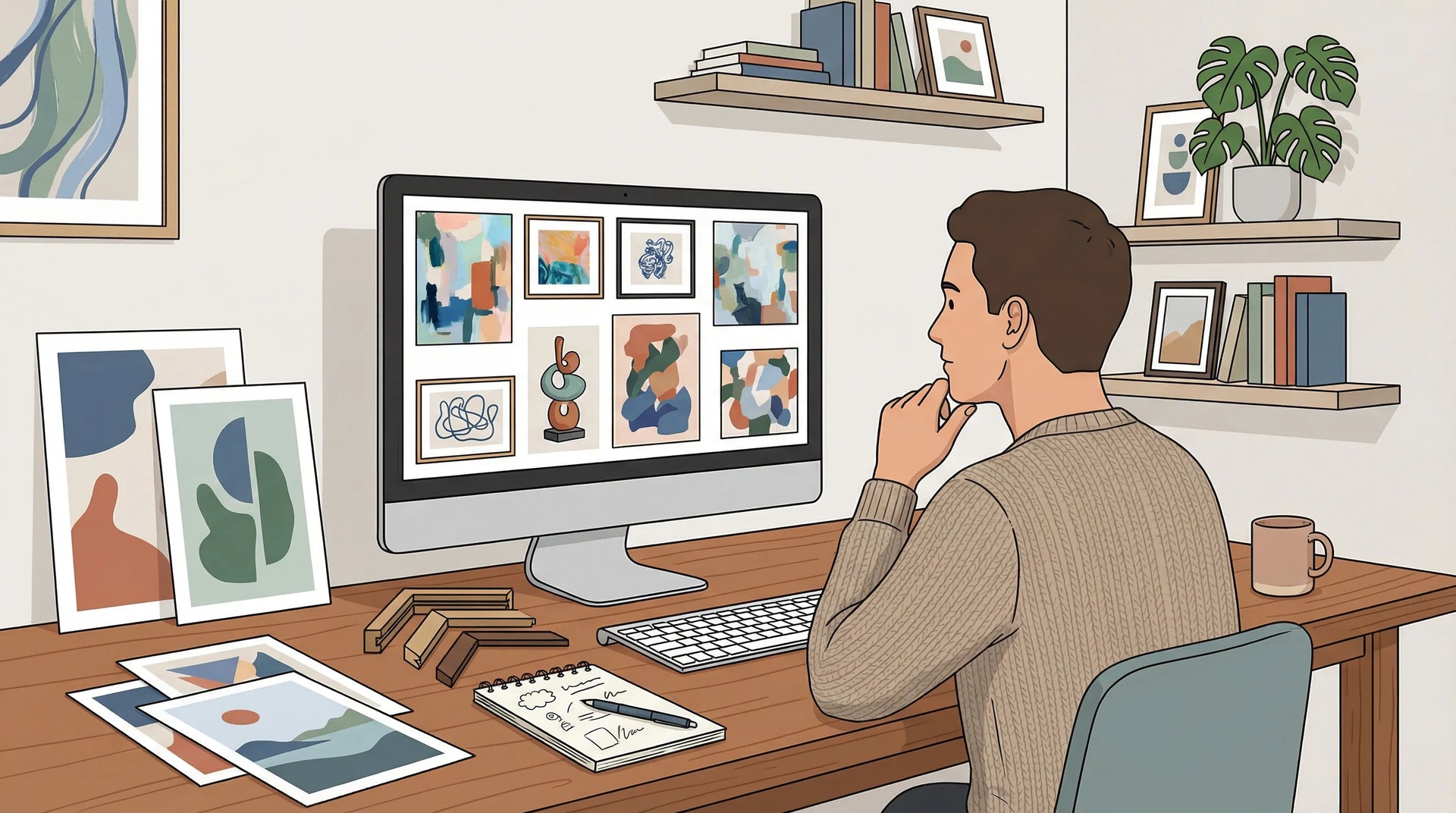
Finding an artist you genuinely connect with is easier than it used to be, and also more overwhelming. There are more places to discover talent than ever, from curated online marketplaces to open studio weekends and graduate shows. The trick is knowing where to browse based on what you want to buy (a ready-to-hang print, a limited edition, or a bespoke commission) and how to quickly tell whether an artist’s work will live well in your space.
This guide breaks down the best places to browse artists right now, what each channel is good for, and how to shortlist with confidence.
First, define what “looking for an artist” means for you
People search “looking for an artist” for different reasons, and the best browsing spots change depending on your goal.
You want art to live with (prints/posters). You’re choosing a piece that fits your home, your budget, and your taste. The fastest route is browsing curated collections, then selecting size and framing.
You want to start collecting (originals or limited editions). You’re looking for provenance, edition details, and a consistent body of work. Online galleries and fairs become more relevant.
You want to hire someone (commission or brand work). You need a portfolio, a brief, and clear usage rights. Professional portfolio platforms and illustration networks make more sense.
If you’re mainly decorating a room (most people are), focus on channels that make discovery and fulfilment frictionless, with clear images, sizes, and shipping.
Best places to browse artists now (and how to use each)
1) Curated print marketplaces (best for “I want something on my wall soon”)
If your priority is finding a style you love and getting it delivered without turning it into a months-long project, curated print marketplaces are hard to beat.
Why they work:
- You can browse by theme, colour, subject, or mood (which mirrors how people actually decorate).
- You’re less likely to get stuck comparing wildly different mediums and price tiers.
- Practical options like multiple sizes and framing reduce decision fatigue.
What to check before buying:
- Whether the work is made to order or shipped from stock (affects delivery times).
- Size options and how the art is cropped across formats.
- Framing availability if you want a ready-to-hang result.
Dreamprint.art sits in this category: a curated marketplace of ready-to-hang posters and art prints from contemporary artists, produced on demand and shipped worldwide, with free shipping.
2) Online art marketplaces and “online galleries” (best for broader discovery)
Large platforms give you a huge pool of artists, often with strong filtering and editorial discovery. They’re useful when you don’t yet know what you like, or you want to compare artists across a movement, medium, or price band.
How to browse efficiently:
- Start with one constraint (colour palette, subject, or medium), then narrow by size.
- Save favourites in a collection so you can spot patterns in your taste.
- Read the artist bio and look for a consistent series rather than one-off styles.
A couple of well-known examples include Artsy (strong discovery and gallery context) and Saatchi Art (broad marketplace with lots of emerging artists).
3) Museum and gallery shops (best for “safe bet” taste, great gifts)
Museum shops are underrated for prints and posters. The curation tends to be coherent, the colour and composition are often display-friendly, and you’ll find exhibition posters that feel both decorative and culturally grounded.
Best for:
- Statement posters tied to major exhibitions.
- Classic artists and movements (when you want something timeless).
- Gifts, because the edit is already strong.
What you might miss: emerging independent artists (unless the institution actively commissions contemporary poster series).
4) Art fairs and print fairs (best for seeing work in real life)
If you can get to one, fairs compress a huge amount of discovery into a few hours. Seeing work in person is still the fastest way to understand scale, texture, and the “presence” of an image.
What fairs are especially good for:
- Meeting artists and asking about process.
- Learning how editions work (and why they cost what they cost).
- Discovering galleries that represent a style you love.
In the UK and internationally, fairs like The Affordable Art Fair are designed for newer collectors and interiors-minded buyers.
Tip: take a quick photo of wall labels (with permission) so you can research later without relying on memory.
5) Open studios and local art trails (best for building a personal connection)
Open studio weekends and local art trails are ideal if you want to buy from an artist you’ve actually spoken to. You’ll see works-in-progress, hear the story behind a series, and often find pieces that never make it onto big marketplaces.
How to find them:
- Search your city or county + “open studios”, “art trail”, or “open house studios”.
- Follow local galleries and councils on social media (they often promote these events).
Why it’s worth it: your purchase becomes a story, not just a product. That emotional connection is a big part of why we keep art around.
6) Degree shows and graduate exhibitions (best for spotting emerging talent)
Graduate shows can be incredible for discovering new voices early, especially in illustration, photography, and contemporary painting.
How to browse thoughtfully:
- Don’t try to see everything. Pick one department (fine art, illustration, photography) and spend time.
- Look for a cohesive body of work and a clear point of view.
- Ask about prints if the original is out of budget (many graduates offer affordable print runs).
7) Portfolio platforms (best for commissions and commercial work)
If you’re hiring rather than buying, browse where professionals present their work in a structured way.
Two mainstream starting points:
- Behance for design, illustration, and mixed media portfolios.
- Dribbble for design and illustration, often more brand and UI adjacent.
How to vet for commissions:
- Look for project case studies, not just single images.
- Check whether the artist shows process, revisions, or sketches.
- Confirm availability, timelines, and usage rights early.
8) Social platforms (best for discovery, weakest for due diligence)
Instagram, TikTok, and Pinterest can be brilliant for stumbling onto artists you would never find through traditional channels. They’re also noisy, and it can be harder to verify what you’re looking at.
Use social well by:
- Following a few galleries, print shops, and curators, then letting the algorithm branch out.
- Saving posts into collections by room (living room, bedroom, office) or by palette.
- Checking for a consistent archive: does the artist have a recognisable style over time?
For due diligence (pricing, editions, shipping, authenticity), you will usually want to move from social discovery to the artist’s website, a reputable marketplace, or a curated shop.
Quick comparison: where to browse depending on your goal
| Where you browse | Best for | Why it’s useful | Watch-outs |
|---|---|---|---|
| Curated print marketplaces | Decor-ready prints and posters | Fast browsing by style, size, and theme | Make sure sizes and framing are clear |
| Online art marketplaces | Broad discovery across artists | Filters, price bands, lots of emerging talent | Quality and fulfilment vary by seller |
| Museum and gallery shops | Classic taste, exhibition posters | Strong curation, giftable, “timeless” options | Less variety in emerging artists |
| Art fairs and print fairs | Seeing work in person | You understand scale and presence instantly | Time-limited, can be overwhelming |
| Open studios and art trails | Personal connection | Meet the artist, hear the story | Events are occasional, not always central |
| Degree shows | Emerging talent | Early access to new voices | Availability and shipping may be informal |
| Portfolio platforms | Commissioning an artist | Structured portfolios, professional context | Not focused on home decor purchases |
| Social platforms | Serendipitous discovery | Great for finding niche styles | Verification takes extra steps |
How to shortlist an artist (without overthinking it)
Once you’ve saved 20 to 40 pieces, you need a way to narrow down that doesn’t depend on mood alone.
Look for consistency, then choose the “best example”
Artists often explore a theme through a series. A series is useful because:
- It shows the artist’s visual language is intentional.
- It makes your choice easier, you’re selecting your favourite within a coherent set.
- It helps if you plan to add a second piece later.
If the artist’s page feels like ten unrelated styles, that can be experimentation, or it can be a sign they’re still finding their voice. That’s not “bad”, but it may be harder to build a cohesive space around it.
Decide what you’re matching: colour, subject, or energy
Most rooms only need one of these to be aligned:
- Colour match: You want the piece to harmonise with a palette (neutrals, earthy tones, bold primaries).
- Subject match: You want a theme (abstract, landscape, typography, portrait, architecture).
- Energy match: You want a feeling (calm, playful, dramatic, surreal).
If you try to match all three perfectly, you’ll reject great work for the wrong reasons.
Validate scale early
A common disappointment is loving an artwork online, then realising it looks small on the wall.
A simple rule of thumb for above a sofa or bed is that the art (or group of art) often looks balanced when it spans roughly two-thirds to three-quarters of the furniture width. You don’t have to follow that, but it’s a useful check before you commit.
If you’re buying prints: what “quality” actually means
“Print quality” can mean several things, and knowing the basics helps you compare across shops and artists.
Things worth checking in a listing
- Print method: common options include giclée (high quality inkjet) and offset (often used for posters). What matters is clarity, colour stability, and how it’s produced.
- Paper and finish: matte vs glossy changes the feel and how light reflects.
- Editioning: limited editions may have a stated run size and sometimes numbering.
- Colour accuracy: reputable sellers photograph consistently and show close-ups.
If edition details matter to you, look for clear language in the product description rather than assumptions based on price.
For wider market context, reports like the Art Basel and UBS Global Art Market Report can be helpful background reading on how people buy and collect art globally.
If you want to commission an artist: browse smarter and brief better
Commissioning is rewarding, but it’s a different process than buying a print.
Where to browse for commission-ready artists
- Portfolio platforms (Behance, Dribbble) for professional presentation.
- Local illustrators and makers you meet at fairs and studio events.
- Artist websites linked from social profiles (often the most up-to-date).
What to include in a good commission brief
A strong brief reduces revisions and protects both sides. Include:
- Intended use (personal wall art, album cover, brand campaign, etc.)
- Size, format, and whether it needs to be print-ready
- Style references (3 to 5 examples) and what you like about each
- Deadline and flexibility
- Budget range
- Usage rights (where it will be used, for how long, in which territories)
If the work is commercial, consider using a written agreement that covers scope, milestones, payment schedule, and licensing. For UK creatives, organisations like the Association of Illustrators publish practical guidance and industry standards.
A simple browsing workflow that saves time
If you’re stuck in endless scrolling, use this flow for one week:
- Day 1 to 2: explore broadly (three channels max).
- Day 3: save 20 favourites.
- Day 4: remove anything you wouldn’t still like in six months.
- Day 5: check sizes and pick the best two formats for your wall.
- Day 6: decide whether you want a single statement piece or two complementary works.
- Day 7: buy one piece you’re confident about, then stop browsing for a bit.
This sounds strict, but it prevents the most common outcome: saving hundreds of images and buying nothing.

Bringing it all together for your space
If you’re looking for an artist because your home feels unfinished, focus on clarity and speed: pick a theme, shortlist a handful of artists, confirm scale, then choose the piece that you would be happy to see every day.
If you’re looking for an artist because you want to start collecting, spend more time on context: read bios, follow a series, and consider seeing work in person at fairs or open studios.
And if you want something you can actually hang without hassle, curated print marketplaces are often the most direct path, especially when they offer multiple size options, framing, and worldwide delivery. Dreamprint.art is built for that use case: contemporary artists, made-on-demand prints, ready-to-hang options, and free shipping.
